Also called Experiment Type 1. Only for continuous characteristics.
In this case, there are three sets of results depending on what "strategy" you take:
- Simple & full
When you have 1 master of type either Working Standard or Measured Part. - Simple & partial
When you have 1 master of type Unmeasured Part or you have only the Adjustment master (comparative characteristic) - Linearity study
When you have 2 or more masters of type Working Standard or Measured Part
Simple full & partial are done when there is only one set of measured values, Linearity study is done for two or more sets of measured values (ideally 3 and more, read below). One Adjustment master is added automatically if a comparative characteristic is selected (there can only be one such master).
Important ! Note that according to ISO 22514-7, you can effectively do two types of studies. One is called Repeatability and Bias Study and the other is called Linearity Study. You can do the Repeatability and Bias Study with more than one master part, in which case the bias is computed as the largest mean deviation from the respective master dimension. In Yarvyn however, having two or more masters automatically leads to Linearity study. Both bias and linearity are then considered to make up the systematic error, while the repeatability (uEVR - uncertainty of equipment variation) is the random error. This is the only place where Yarvyn differs from the ISO standard (excluding things we have added as a bonus like "Adjusted bias" and "Adjusted uEVR").
If you want to find out more, read our article Bias and Linearity.
What is common to all three sets of results
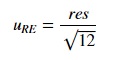
Uncertainty of resolution (uRE) User can input resolution (res) on step 3. The value is then computed as
Other uncertainties (uother) are always computed as B type.
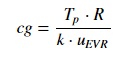
Cg and Cgk are calculated as follows:
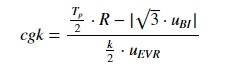
Tp ... 0.2
R ... upper specification limit - lower specification limit
k ... 6
uBI ... uncertainty of bias
uEVR ... uncertainty of equipment variation
Measurement System Uncertainty (uMS)

where uEV is

Measurement System Uncertainty Expanded (UMS) is simply twice the uMS.
Capability ratio (QMS) and Capability index (CMS)
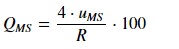
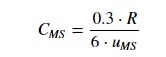
R stands for the range of reference interval. User can input three types of reference interval and their hierarchy is described here.
Simple full & partial
What is common to Simple full and partial:
Uncertainty of equipment variation (uEVR) is the sample standard deviation.
Uncertainty of linearity (uLIN) can be computed as B type.
Adjusted uncertainty of equipment variation (uEVR) is calculated when Trend Improvement is turned on. It is calculated from the regression line. Each measured value has a fitted value on the regression line. The difference of these is called residuum. Adjusted uEVR is the sample standard deviation of these residuals. This value is then involved in the calculations of adjusted cg, cgk, ums, UMS, QMS and CMS.
Simple & partial
Bias (bi) is not computed, because the master does not have a reference value. In the case of adjustment master, it is pointless to use this master to check the bias of the device.
Uncertainty of bias (uBI) can be computed as B type.
Uncertainty of calibration (ucal) is not computed because the master is not calibrated.
Simple & full
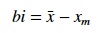
Bias (bi) is the difference between average and master reference quantity value (dimension)
Uncertainty of bias (uBI)
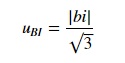
Uncertainty of calibration (ucal) can be computed as B type.
Adjusted bias
Besides the adjusted uEVR we also compute the corrected bias. It is the difference between master reference quantity value and first fitted value.
Linearity study
Uncertainty of equipment variation (uEVR)
Uncertainty of bias (uBI)
Uncertainty of linearity(uLIN)
These values are all computed using the regression line in this case. If you only have two useful master parts, the systematic error can be fully rectified by linear adjustment and so the bias shrinks to nothing. Therefore to make the full Linearity, Repeatability and Bias study, it is advisable to have at least three master parts with known dimensions.
uLIN is computed using the Specification limits. The maximum from fitted values of the lower and upper limit divided by √3 is chosen as the uLIN. In case user did not input specification limits, the lower limit is considered to be the smallest reference value of the masters and the upper limit is considered to be the biggest reference value of the masters.
To get uEVR and uBI, we do one-way ANOVA.
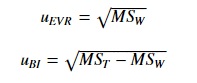
In accordance with the terminology used in ANOVA:
MSW ... mean sum of squares within groups
MST ... total mean sum of squares
Like this, the calculation of uLIN and uEVR is consistent with the aforementioned ISO standard. The calculation of uBI however, is different. We strongly believe that the division of systematic error into bias and linearity is correct. Read about it in the article Bias and Linearity.
Comments
0 comments
Please sign in to leave a comment.