Terminology of Bias and Linearity is not consistent across different standards (ISO 22514-7, VDA5, AIAG MSA 4, ...). This is due to the simplifications needed to have an "industrialized" and practical uncertainty study.
Generally, the Bias, i.e. the systematic measurement error, is different in different parts of the measured range. But how can one have a single Bias uncertainty, if it depends on the measured value? Well, this is exactly where the simplification steps in. It is customary to be conservative and to display the worst case. This means that if the error is close to zero at one end of the reference interval and "big" at the other end, the "big" error is used on the whole reference interval. This can make the systematic error unnecessarily big. Linearity however, introduced in some standards like ISO 22514-7, can help you identify and reduce some of it. Linearity is not codified in metrology bibles, although it is very practical in the real world, as many measuring devices can be adjusted by setting the "zero" and the "amplification", which correspond respectively to the "A" and "B" in a general linear function y = A + B *x. In Yarvyn you will find this:
Linearity (LIN) is the systematic error that you can rectify by making linear adjustment to the measured value. This can be imagined as adjusting the "zero" and the "amplification" on the measuring device. This is like saying: "If you make the measurement more linear, you will reduce the linearity error."
Bias (BI) is the systematic error that remains after the linear correction. Some error can remain since not all of it can be rectified by a line. What remains may be periodic error, progressive (i.e. - quadratic or cubic) error, and others.
Note that this is effectively subdividing the systematic error into two parts: the Linearity and the Bias. In this context, the Bias is the systematic error on top of the Linearity error.
The equipment variation on the reference (EVR) is the random error on top of the systematic one, i.e. on top of the Bias which is on top of the Linearity.
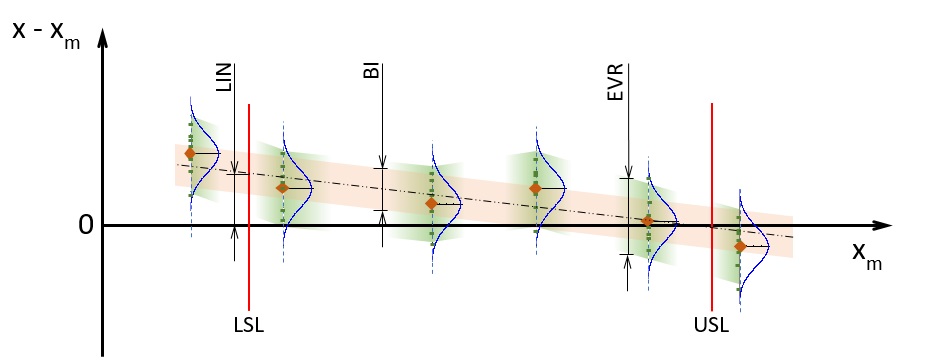
On the picture above:
x ... measured values
xm... master reference quantity value
LSL ... lower specification limit
USL ... upper specification limit
(lower and upper limits of the reference interval, in general)
Note that in different standards you may find the Linearity and the Bias used with swapped definitions, or Bias to be the total systematic error, while linearity is its part, or the linearity is completely omitted.
Comments
0 comments
Please sign in to leave a comment.