For the case when you have one master with a reference value and the measured characteristic has two sided limits, we can predict outcome of the experiment.
Prediction is not possible for the Linearity and Bias study (2 or more masters) or when the measured characteristic is missing reference value or two sided tolerance limits.
Outcome of the experiment is determined by Qms. If Qms < 15%, we're good.
The formula for Qms is:
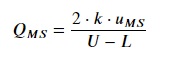
k is the coverage factor (a pre-defined constant)
U (L) is the upper (lower) specification limit.
Taking the square of this expression and isolating uMS on one side we get:
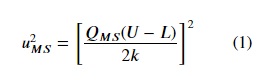
The formula for uMS, uncertainty of measurement system, is:

Except for uEV and uBi, all the other uncertainties are B type, so they are known. Let's denote
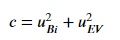
By equating (1) and (2) and using the substitute c we get:
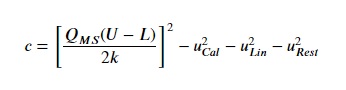
Putting QMS = 0.15, turns the right hand side of this equation into a number constant. The procedure for prediction then takes the values that have been measured so far (min. 8) and tries to predict if c will be less than 15%. Notice that the B type uncertainties can be so big, that the value of Qms is already greater than 15% (which is considered NOK outcome). In this case, you don't even have to measure anything.
It can happen that you have measured relatively many values (more than 15) and the result of prediction is still undecided, i.e. that more values are needed. The underlying algorithm reaches a conclusion quickly in cases where Qms would be far from 15% on either side, so ideally you don't have to waste resources to measure another value. In cases where it's very close to 15%, the algorithm may often ask for more values to be measured.
Comments
0 comments
Please sign in to leave a comment.